Curved LED screens often fail in the content file, not on the job site. The hardware may be aligned, bright, and well installed, but the visuals still feel awkward because they were designed like a flat billboard.
A curved flexible LED screen needs content that respects shape, viewing angle, and movement through the space.
Design for Real Viewing Positions
Start by mapping where people will stand and walk. A curved corporate lobby wall may be viewed from the front and both sides. A retail column may be seen in fragments. An exhibition curve may pull people from an aisle into a booth.
The content should be designed for those positions, not for a perfect front-facing screenshot.
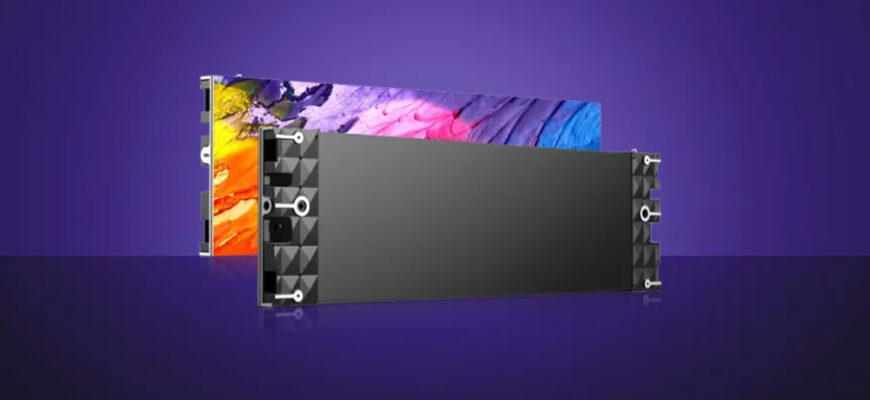
For indoor fixed projects where image quality and close viewing matter, a reference such as esdled.com BIM Pro can help teams think through pitch, resolution, and indoor display requirements.
Keep Important Elements Off the Tightest Curve
Logos, faces, product labels, and small text should not sit across the most distorted part of the curve. Put key information on flatter or more front-facing zones. Use the curved areas for motion, color, texture, and spatial transitions.
This does not mean curved content has to be boring. It means the most readable elements should land where viewers can read them.
Use Motion That Follows the Geometry
Motion can make a curved screen feel intentional. Horizontal sweeps, slow gradients, environmental loops, and panoramic video can work well. Fast edits and tiny details may feel chaotic when wrapped around a curve.
For exhibitions and stores, content should also loop gracefully. Visitors may enter the experience at any point in the loop, so the message should not depend on a long beginning-to-end sequence.
Test With the Actual Pixel Map
A pixel map tells the media server how the content fits the physical LED layout. Curved screens, corners, and staggered designs often need custom mapping. Without it, content can stretch, break, or appear in the wrong place.
IEEE research on large curved displays has shown that user experience changes when people interact with content across wide or curved visual fields. For commercial displays, the same idea applies: layout and navigation must reflect the screen shape.
Plan Text Like Signage, Not a Website
Curved LED screens are usually not the place for paragraphs. Use short lines, strong contrast, and large type. If the viewer is moving, assume only a few words will be read at a time.
For corporate spaces, a curved screen can rotate between brand storytelling, data visualization, event schedules, and ambient visuals. Each content type should have its own layout rules.
The Screen Shape Is Part of the Story
Good curved LED content does not hide the curve. It uses it. A product reveal can travel around a corner. A brand color wave can guide people through a space. A lobby timeline can unfold along the wall.
For indoor installations that need a stable, close-viewing display foundation, the BIM Pro indoor fixed LED screen is a useful page to review while planning content requirements and display specs.
The goal is not to fill every pixel. It is to make the curve feel like it was always part of the message.